OPINION Opinion
In Philadelphia, the Fine for a Ski Mask Matches the Fine for Breaking Ethics Laws
We took a deep dive in city ethics violations. The penalties have become comparable to filing fees.
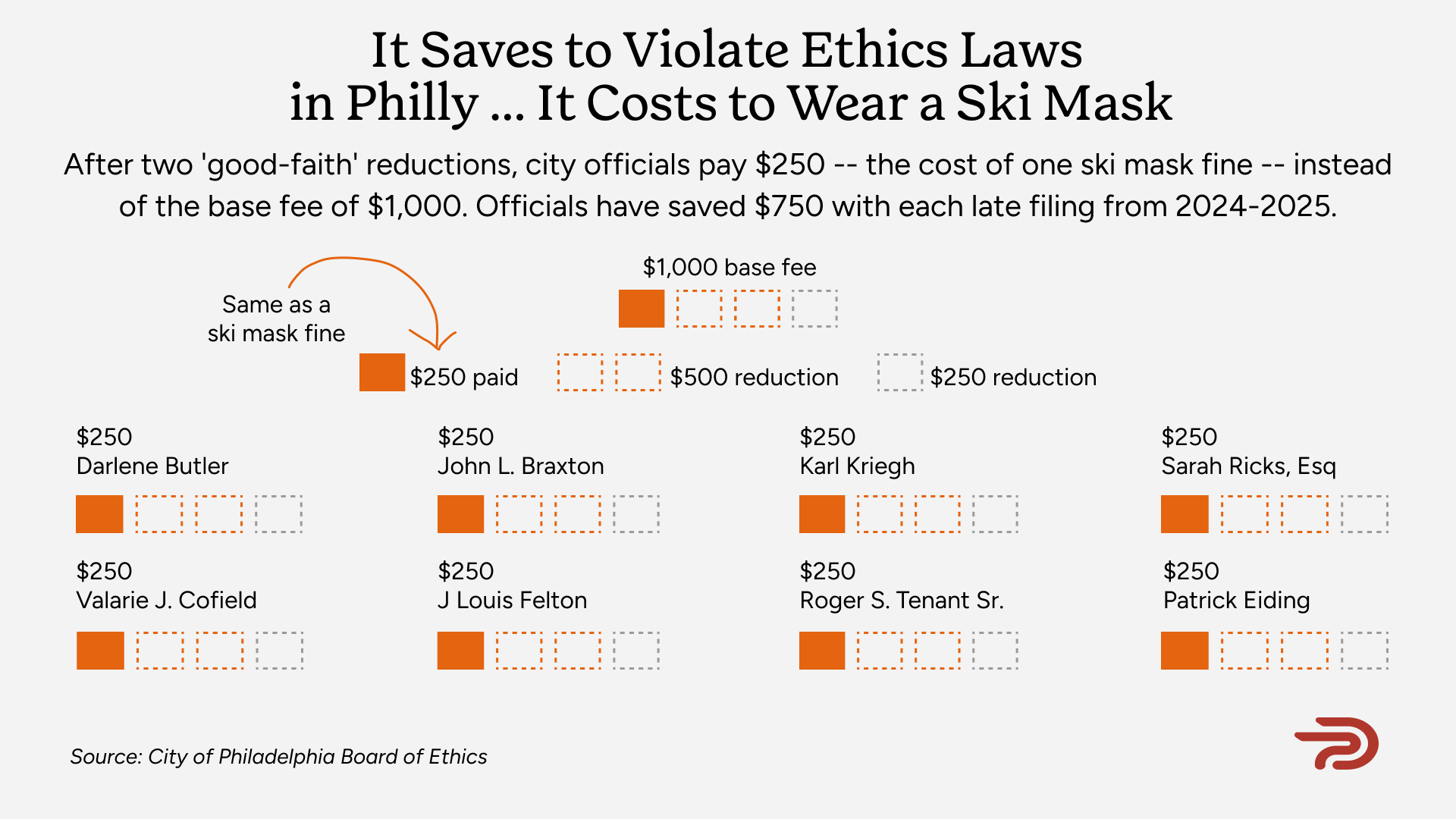
In October 2025, Patrick Eiding, a sitting member of Philadelphia's City Planning Commission, settled with the city's Board of Ethics for failing to file his legally required financial disclosure. His penalty: $250. That same month, Darlene Butler settled the same violation for the same amount. In September, four more city officials did the same, each paying $250. In November, John L. Braxton, a member of the Board of Revision of Taxes, joined them.
Of the 14 settlement agreements the Board of Ethics approved in 2024 and 2025, eight were for $250. Every one resolved the same violation, a city official failed to disclose their financial interests on time. Every one followed the same script. The official eventually filed the form. The Board assessed its standard fine. A PDF was posted to the city's website. And life went on.
This is Philadelphia's ethics enforcement regime. And for the people and institutions that treat these rules as suggestions, it has become indistinguishable from a filing fee.
The clearest illustration came in February 2025, when the Board settled with the International Brotherhood of Electrical Workers Local 98 for years of unreported lobbying activity tied directly to one of the most significant federal corruption cases in Philadelphia's modern history. The settlement agreement details how John “Johnny Doc” Dougherty, while serving as Local 98's business manager, directed extensive efforts to influence city government between 2014 and 2016 without ever registering as a lobbyist or filing a single expense report. According to the agreement, Dougherty lobbied on the Comcast franchise renewal, pushed for stop-work orders at the Children's Hospital of Philadelphia, strategized on the Philadelphia Beverage Tax, and provided luxury Eagles box tickets to then-Councilmember Bobby Henon to help advance the union's interests with other Council members.
Henon was sentenced to three and a half years in federal prison for taking bribes from Dougherty. The sentencing judge said the case “exposed the dirty underbelly” of city politics. Dougherty himself received six years after being convicted of both bribery and embezzling nearly $600,000 from the union he ran. He reported to federal prison in Lewisburg in October 2024.
And the city ethics penalty for the lobbying violations underlying all of that? $24,600. That figure represented the Board maxing out its statutory authority, applying the $2,000 per violation cap across 11 separate failures to register and file, plus registration fees. The Board did everything the law allowed it to do. The law just does not allow very much.
The penalty structure in the Philadelphia Code sets a base fine of $1,000 for most ethics violations. If mitigating factors are present, like a good-faith effort to comply or prompt corrective action, the fine drops to $500 with one factor and $250 with two. That is how you get a city official who sat on a financial disclosure for months to pay only $250, the same fine for wearing a ski mask in public in Philadelphia. Even with aggravating factors like intent or obstruction, the maximum only reaches $2,000 per violation.
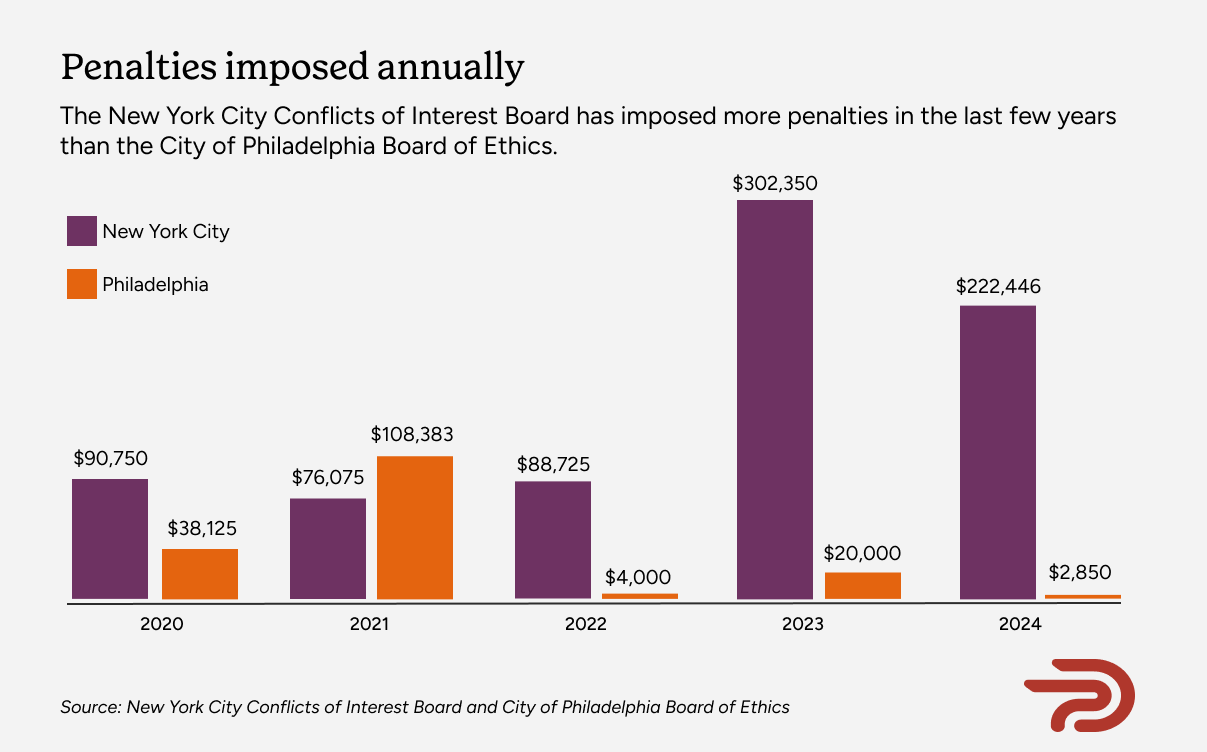
Compare that to New York City. The Conflicts of Interest Board there can levy fines of up to $25,000 per violation and order disgorgement of any financial gain. In practice, the city routinely imposes penalties of $7,250, $10,000, $22,500, and $25,000 on individual public servants. Philadelphia's statutory ceiling is New York's floor.
What makes the current system corrosive is that the same names keep appearing. Former Councilwoman Jannie Blackwell settled with the Board in 2024 for political activity violations, paying $2,000. She had also settled in 2016 and 2012. District 1199C PAC settled in 2019, 2018, and 2015. Taubenberger for Philadelphia settled in 2021, 2016, and 2011. Former Councilman Allan Domb settled twice, in 2022 and 2020. Local 98 itself had a prior settlement in 2008. When the penalty for a second offense is the same as the first, the fine has become a line item, not a deterrent.
In December 2025, the Board voted unanimously to let staff resolve financial disclosure non-filing violations administratively, without full Board approval, as long as the violation is corrected within 30 days. The move may reflect efficiency. It also means the $250 settlement has become so routine it no longer requires deliberation.
The Board of Ethics is not the villain here. Its staff is small and even organizations like the Committee of Seventy have rightly argued that the Board needs to be fully funded to enforce the laws it oversees. City Council has the power to raise the statutory caps. Since the Dougherty and Henon convictions, it has not advanced any such reform.
Philadelphians deserve an ethics enforcement system that treats violations as something more than an inconvenience. Right now, if you are a public official in this city and you break the rules, the worst that can happen is a fine you could cover with what is in your wallet. That is not a real consequence.
-

Rotimi Adeoye
Rotimi Adeoye is a Philadelphia-based writer and columnist at The Daily Beast covering history, voting, and constitutional law. Formerly a speechwriter and Capitol Hill aide, he appears on MSNBC and writes for major publications.