What ICE's $87.4 Million Warehouse Purchase in Berks County Means for Pennsylvania
Philadelphia often describes itself as a city that limits entanglement with federal immigration enforcement. That identity matters, but the Berks County facility exposes its limits.
When federal immigration officials quietly purchased a 520,000-square-foot warehouse in Upper Bern Township, Berks County, local officials learned about it the same way most Pennsylvanians did: after the deal was already done.
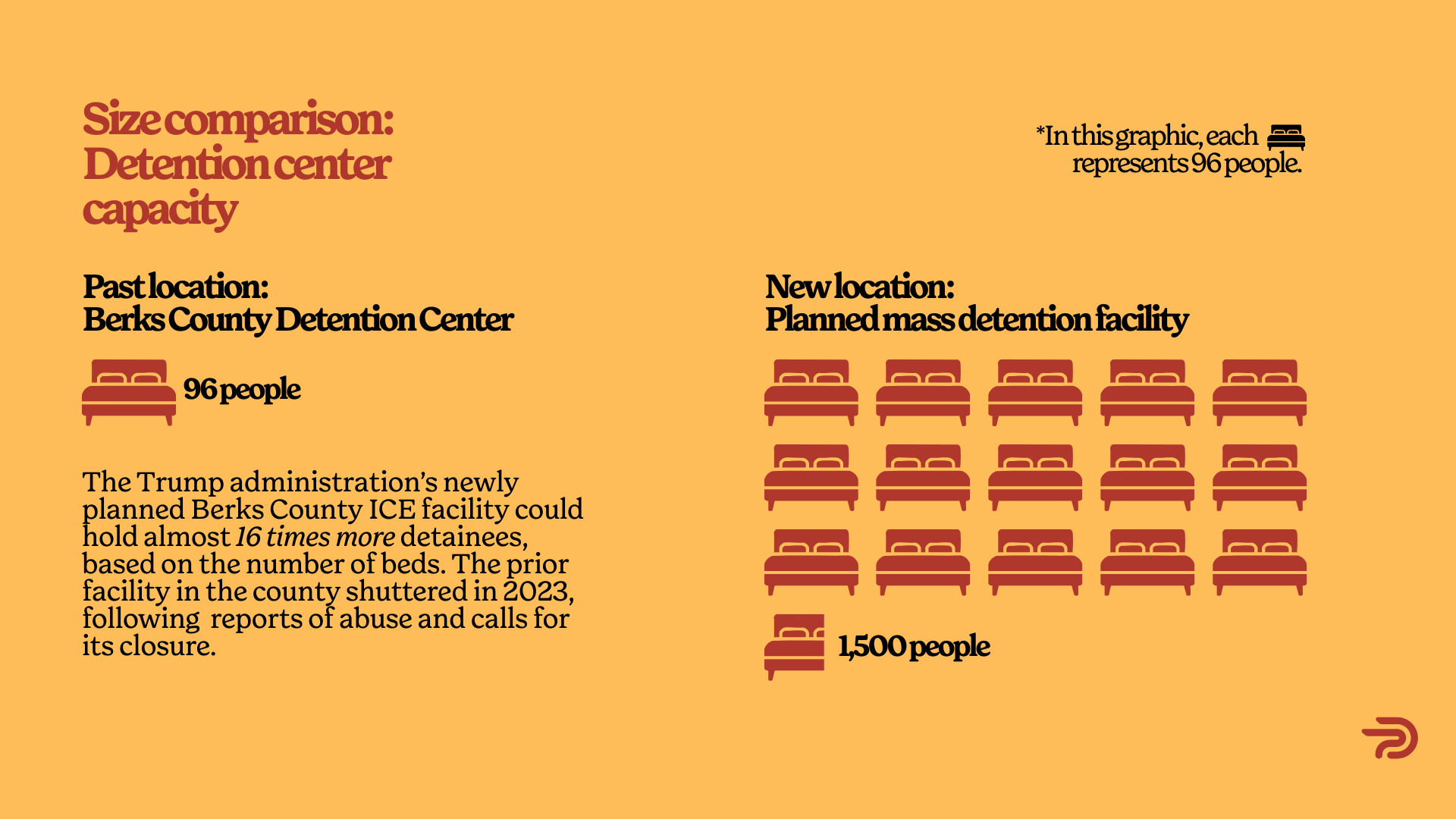
Immigration and Customs Enforcement (ICE) plans to convert the site into a detention facility capable of holding as many as 1,500 people; the old facility could hold 96 people. If it becomes operational, Berks County will once again sit at the center of immigration detention in Pennsylvania, a fact that matters for Philadelphia, where many of the people detained at this facility are likely to be arrested, processed, or ultimately transferred.
The purchase is part of a broader national push to expand detention capacity by repurposing warehouses and industrial properties. These facilities are rarely placed at random. They are located within reach of major cities but far enough away to avoid sustained public scrutiny. In Pennsylvania, that means a detention center that is not in Philadelphia, but close enough to function as one of its primary detention endpoints.
Eastern Pennsylvania has long been at the center of legal battles over immigration enforcement.
🏛️ In 2014, the Third Circuit ruled in Galarza v. Szalczyk that Lehigh County was not required to honor ICE detainer requests, establishing nationwide precedent that such requests are voluntary rather than mandatory.
🏛️ Years later, a federal court ruled in E.D. v. Sharkey that a detainee at the Berks County Residential Center could sue for sexual assault regardless of whether she appeared to consent, recognizing the inherent power imbalance in detention.
🏛️ And in Lozano v. Hazleton, courts struck down the City of Hazleton's anti-immigration ordinances as unconstitutional, a decision the Supreme Court declined to disturb. Despite these rulings, Berks County continues to comply with ICE detainers even when it is not legally required to do so.
For Philadelphia's immigrant communities, people picked up by federal agents in the city often do not stay there. They are transferred to facilities in surrounding counties, making it harder for families to visit, for lawyers to respond quickly, and for community organizations to track cases. A 1,500-bed facility in Berks County turns detention into a regional system that Philadelphia's legal and social infrastructure will be forced to absorb.
None of this was discussed publicly before the purchase. Upper Bern Township was not asked whether it wanted to host a large detention operation. County officials were not consulted about infrastructure capacity or emergency services. Philadelphia leaders were not asked how an expanded detention pipeline would affect already-strained legal defense networks. The decision was made unilaterally, with local governments left to deal with the consequences.
Governor Josh Shapiro has strongly opposed the purchase, calling the process "shady" and saying the federal government's approach erodes public trust. He is exploring what legal options the state may have to stop it, while acknowledging that those options are "fairly slim" given that the federal government is the purchaser. That reality is important, but it does not mean Pennsylvania is powerless. It means the state must stop reacting to federal actions but be prepared for them.
Senator John Fetterman, a strong supporter of the Trump administration’s immigration policies, has surprisingly been more explicit about the downstream effects. In a letter to DHS Secretary Kristi Noem, he warned that detention facilities of this size strain local infrastructure, drain public resources, and deprive communities of tax revenue while offering little in return, citing a projected combined loss of more than $1.6 million in annual property taxes across Berks and Schuylkill Counties.
The contrast with Philadelphia's budget debates is hard to ignore. While ICE can spend $87.4 million on a single building without public input, Philadelphia repeatedly struggles to fund the legal services that prevent unnecessary detention in the first place. City leaders and advocates have spent years fighting for immigrant legal defense funding. People with lawyers are more likely to appear in court, more likely to win relief, and less likely to be detained for long periods. Yet those investments remain fragile and politically contested.
Detention, by contrast, is treated as inevitable. Federal dollars flow easily toward beds and guards, while cities like Philadelphia are left to patch together legal and social support systems after people have already been detained, a policy choice that prioritizes containment.
Philadelphia often describes itself as a city that limits entanglement with federal immigration enforcement. That identity matters, but the Berks County facility exposes its limits. A sanctuary policy cannot prevent the federal government from building detention capacity nearby. It cannot stop people arrested in Philadelphia from being transferred out of the city. And it cannot shield families from the disruption that detention causes once capacity expands.
This is why the Berks purchase should concern Pennsylvanians far beyond the township where the building sits. Pennsylvania has lived through this debate before. The former Berks County Residential Center became a national symbol of the harms of family detention, closing only after years of litigation and public pressure.
If Pennsylvania wants to avoid repeating that cycle, it needs a coordinated response that strengthens immigrant legal defense statewide, sets clearer limits on state cooperation, and demands transparency when federal agencies acquire property for detention purposes.
The Berks County warehouse is a reminder that immigration policy is shaping where people are detained and which communities bear the costs. For Philadelphia and for the rest of Pennsylvania, the question is whether leaders will continue to react after the fact or whether they will finally plan for the system being built around them.
-

Rotimi Adeoye
Rotimi Adeoye is a Philadelphia-based writer and columnist at The Daily Beast covering history, voting, and constitutional law. Formerly a speechwriter and Capitol Hill aide, he appears on MSNBC and writes for major publications.